
Colossians 2:6 (ESV) 6 Therefore, as you received Christ Jesus the Lord, so walk in him,
 Did the title confuse you? Did it seem counter intuitive? Have you not asked God for help? And if that is the case why the title?
I want you to stop and think for a moment. When you came to Christ did you come to Him asking for help or did you come to Him as He moved you to repentance and to salvation? Did you somehow participate in your salvation, which “help” implies, or were you a recipient of His grace in salvation acknowledging your total helplessness?
Paul made it clear to Titus that our salvation was not brought about by any righteous acts on our part but according to His grace and mercy (Titus 3:5). We didn’t somehow get to a place of certain righteousness, or willingness (Romans 3:10), however imperfect, and then God finished the work of salvation. No, it was while we were going our own way, with no understanding of the true nature of God (Romans 3:11). We confessed we were helpless and that no amount of self-effort would save us from His wrath. It would only be by the initiative God drawing us to himself (John 6:44) and Christ taking our place in judgment for sin we would be saved (Romans 3:24; I John 2:2; 4:10). It was a complete work of God from beginning to end. Continue reading
 Ephesians 2:10 (ESV) 10 For we are his workmanship, created in Christ Jesus for good works, which God prepared beforehand, that we should walk in them.
 Martin Luther, following the Diet of Worms in April 1521 came to the conclusion that the central issue that he had with Rome was the doctrine of ”sola fide” – faith alone. This is the instrumental cause or the means by which justification comes to the believer. So, for Luther the doctrine of justification by faith alone was the preeminent doctrine on which the whole of the Gospel stood.
 It may be easy for you see how repentance has been eliminated from our modern-day gospel message. And for some it may seem as if I have added a work called repentance to the Gospel. Of course you can only come to that conclusion if you take a semi-Pelagian* view and believe that somehow out of man’s own perceived inherent goodness he is capable of stirring up a repentant heart. But on the other hand if you see repentance as a gift from God (Acts 11:18; 2 Timothy 2:25) and tied directly to God’s gift of faith (Ephesians 2:8-9), then there is no work involved but rather God’s grace effectually working in the life of the sinner. As I mentioned in the last article, repentance and faith are often used interchangeably. This kind of saving faith is the instrument in which we embrace Christ. So then it is by grace alone, though faith alone, because of Christ alone.
  Revelation 2:4-5 (NKJV) 4 Nevertheless I have this against you, that you have left your first love. 5 Remember therefore from where you have fallen; repent and do the first works, or else I will come to you quickly and remove your lampstand from its place–unless you repent.
 It never ceases to amaze me how the Gospel message finds itself under attack in the name of evangelism. While the message is simple it is not simplistic. Just what do I mean by that? Often the Gospel message is boiled down to “Jesus loves you and has a wonderful plan for your life”, or “Ask Jesus into your life and He will forgive your sins and give you eternal life.”. This is a reductive theological gospel message. It is missing a number of critical components and leaves the hearer with an “easy believism” gospel. This kind of gospel message ignores among a number of things, the critical doctrine of Biblical repentance and makes no demands of real fiduciary faith upon the hearer that brings about life transforming results ( 2 Corinthians 5:17; James 2:14,17). This is not a statement of infusion such as the Roman Catholic Church holds in sacramentalism but rather a declaration of the result of saving grace (imputed righteousness) that produces a new creation, new desires, and Christ honoring works (Ephesians 2:10) which are the natural fruit of the “New Man” ( Ephesians 2:15; 4:24; Colossians 3:10) birthed in the believer through the regenerating work of the Holy Spirit (John 3:5). So let’s take a look at the deficiencies of the reductive gospel so prevalent today. In this first article we will take a brief, critically targeted, certainly not comprehensive looks at the missing message of repentance.
  t at All. The name of the post comes from a quote from C.S. Lewis; “We make men without chests and expect of them virtue and enterprise.” C.S. Lewis, “The Abolition of Man” (New York: Touchstone, 1996), pp. 35. The point is that we need believers, men and women of strong conviction, strong hearts, filled with the truth of God. That is the emphasis of
  As we approach this Christmas season, I thought I would take a moment to reflect on that event and its implications to the life of the believer.
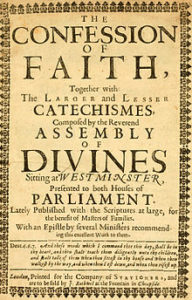 Whenever I hear someone critical of the doctrine of the security of the believer, and properly called the “perseverance of the saints”, the question comes up; “Is he a Baptist?” This doctrine is not peculiar to Baptists but is held by a great many evangelical groups and was beautifully expressed by Reformed Theology in the Westminster Confession of Faith. Here it is in part: